

Demilitarize McGill Archive
Military Research at McGill
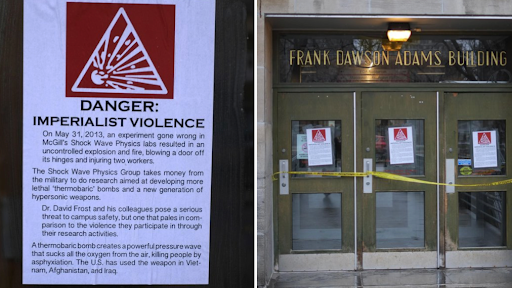
Military-funded research, research with clear applications to weapons development, and projects designed to provide ideological support to western military agendas take place across an array of labs, research groups, and academic institutes at McGill. Learn about some of the forms military research takes here.
Drone Research at the Aerospace Mechatronics Lab
Documents obtained through an access-to-information request to the Department of National Defence (DND) reveal that Prof. Inna Sharf and her team at the Aerospace Mechatronics Lab are conducting research to develop autonomous landing systems for UAVs, under a contract worth $380,000. The technology will contribute to “decisive operations in the urban battle-space” by “providing situational awareness to dismounted soldiers,” the documents state. The project, entitled “Autonomous Support for UAVs,” involves the development of software to enable drones to autonomously land on static and moving targets, such as rooftops and armored personnel carriers. The technology will reduce the workload of dismounted soldiers and improve data collection and surveillance capabilities.
The DND researchers collaborating with McGill propose a strategy for urban warfare reliant on “small, highly maneuverable UAVs” that include armed “strikebots,” indicating that McGill’s research could contribute to weaponized drone technology. DRDC-Suffield, the military research agency responsible for the contract, spells out the nature of the intended application of the research in its request for proposals: “[UAVs] must not compromise operator safety but provide battle-space awareness that provides a force multiplier to the dismounted soldier unit.”
Sharf’s team is using computers from the Centre for Intelligent Machines Laboratory to develop the software. They have conducted flight tests at the Aerospace Mechatronics Laboratory and at Macdonald campus. Sharf suggested the latter location in her bid due to its “secluded open areas.”
Following these revelations in March 2014, Demilitarize McGill held a blockade of the Aerospace Mechatronics Lab lasting nearly four hours. The McGill administration called the police onto campus to end the protest.
In the media: McGill Daily
The CFD Lab
The Computational Fluid Dynamics (CFD) Laboratory in the Department of Mechanical Engineering specializes in the research and development of complex 3D modeling software for use by the aerospace industry.
Drones
Right now, CFD lab research is chiefly oriented towards the development of both simulation software and anti-icing technology for unmanned aerial vehicles (UAVs), including attack drones used by the U.S. military to kill people. The simulation software developed by the CFD lab is called FENSAP-ICE, and it is used both to optimize the design of the drone itself and to develop discrete anti-icing systems. Advances in this field have been very important for Western militaries that increasingly rely on drones for attack power. In the course of filling the skies with armed UAVs, the United States and other countries have encountered specific physical constraints, and perhaps the foremost amongst these has been bad weather. As lab director Dr. Wagdi Habashi noted in a 2009 paper, UAV missions during the NATO “engagement in Afghanistan” were marked by “unforeseen mid-level icing encounters.” This signaled a need for new forms of ice protection, to be modeled and refined with FENSAP-ICE. (1) CFD lab research aims to solve a specific technological problem affecting military strategy: the need for versatile and resilient drones that can fly at high speeds and altitudes, and that can complete their missions in cold, icy conditions if necessary.
The lab is funded in large part by aerospace manufacturers Bombardier, CAE, and Bell Helicopter Textron, all of which are invested in the advancement of military objectives. In August 2013, Montréal-based CAE entered into an agreement potentially worth $100 million with the United States Air Force to train drone pilots. The technology required to fulfill this contract is precisely what CFD lab research is structured to provide. Bombardier is also in the business of military flight training, and Bell Helicopter makes military helicopters. These relationships, and the fact that nearly all CFD lab research is oriented towards the development of a commercial product, raise the question of whether research priorities are set by academics or by the R&D departments of the for-profit companies funding the lab.
In 2004, Dr. Habashi co-authored a paper called “FENSAP-ICE Applications to Unmanned Aerial Vehicles” with engineers from the unmanned air combat systems division of Northrop Grumman, the defense contractor which manufactures the Global Hawk, Fire Scout, and Hunter UAVs for the U.S. military. (2)
In addition to directing the CFD lab, Dr. Habashi acts as the CEO of Newmerical Technologies, a company operating out of a McGill office which sells the product of the CFD lab’s research, FENSAP-ICE, to aerospace companies, including military UAV manufacturers. Because Newmerical is a private company, it’s harder to obtain information about its activities, and therefore harder to get a clear picture of the ultimate applications of research being done at McGill, a public institution. But we do know some things. For example, in 2002, Newmerical entered into an agreement with a California-based company called Ice Management Systems (IMS) to collaborate on adapting its “Electroexpulsive Separation System” to UAV applications. According to NASA, this system has become an “ideal solution to the UAV icing dilemma,” and its buyers include General Atomics, the manufacturer of every attack drone in the current U.S. military arsenal.
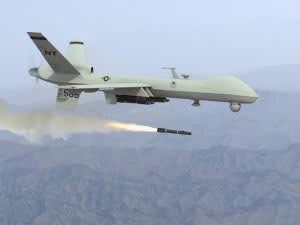
Under President Barack Obama, the United States has greatly escalated its “covert” drone war in Pakistan, Afghanistan, Yemen, and Somalia, resulting in the expansion of the country’s UAV fleet and an ever greater demand for UAVs and the relevant technological advancements. Drone-related research taking place at universities cannot be considered in isolation from the real-world application of that research, which, in this case, is deadly. The Bureau of Investigative Journalism estimates that, from 2004 to 2013, between 2,535 and 3,576 people were killed by U.S. drone strikes in Pakistan alone, including between 411 and 884 civilians, and between 168 and 197 children. Right now, the American drone war has no end in sight.
Fighter Jets
Dr. Habashi, through Newmerical Technologies, sold FENSAP-ICE to Lockheed Martin in the early 2000s for use in the development of the F-35 fighter jet. A product of the U.S. Joint Strike Fighter program, the F-35 is a “next-generation” fighter jet, expected to provide the majority of the United States Air Force’s lethal airpower in the coming decades. The U.S. intends to buy 2,433 of the aircraft, and other buyers include Canada, the United Kingdom, Australia, and Israel.
These known applications of FENSAP-ICE are illuminating with respect to the purposes of the CFD lab’s research. The lab has been defended on the basis that its work could just as easily assist civilian aircraft development, but the reality is that there is little demand for this kind of technology coming from, for example, the civilian airline transit industry. That’s because large commercial jets, unlike drones, are not in danger of crashing due to inadequate anti-icing technology. FENSAP-ICE is most useful specifically in those development settings where there is currently a demand being issued for technological advances on this front – where the interplay of factors like aerodynamics and ice accretion must routinely be simulated for novel aircraft designs. These settings are nearly exclusively military in nature.
The fact that the research done at the CFD lab is used by the military cannot be viewed as a simple coincidence. If the armed forces of various countries weren’t demanding a very specific kind of technological development, the lab would have little to no reason to exist.
CFD/Newmerical U.S. Collaboration
Newmerical Technologies, the company founded by Dr. Wagdi Habashi, the head of McGill’s Computational Fluid Dynamics Laboratory, appears to be concentrating more and more on military-related contracts. Newmerical’s website advertises a combined sales and engineering position at the company’s future office in Daytona Beach, Florida. Crucially, the advertisement stipulates that all candidates must be American citizens “in order to apply for a security clearance for ITAR-restricted work.” The acronym ITAR stands for “International Traffic in Arms Regulations”, a subchapter of the United States Code’s Foreign Relations section, which regulates the import and export of military technology.
Newmerical’s choice of location for its American branch office is also revealing. Daytona Beach is home to Embry-Riddle Aeronautical University, a leader in aerospace engineering and a site where United States Air Force pilots get trained. Dr. Habashi – who, again, is head of both the CFD lab and Newmerical Techologies – has recently developed links with this private American university. In February 2013, Habashi and Stephen Yue, the director of McGill’s Institute for Aerospace Engineering, attended an event at Embry-Riddle marking the donation of two jet engines to the school’s Gas Turbine Laboratory by engineering company Pratt & Whitney, of which Habashi is a research fellow. In June 2013, Habashi presented a paper on synthetic jet actuators at the 21st AIAA Computational Fluid Dynamics Conference in San Diego, California; the paper was co-written with Dr. Vladimir V. Golubev, a professor at Embry-Riddle, and Nikisha Nagappan, a former Embry-Riddle graduate assistant who has since become an engineer for GE Global Research. (3)

The collaboration with Embry-Riddle, and in particular with Dr. Golubev, underscores the military orientation of work being done on McGill’s campus. Golubev’s research is partially funded by the United States Air Force’s Research Laboratory and Office of Scientific Research, and his research presently focuses on using micro-air vehicles (i.e. small-sized drones) in “gusty urban environments.” Thus far, the military use of smaller drones has been restricted to surveillance, but there are plans for such aircraft to eventually serve as kamikaze-style attack drones. (4) In February 2013, Golubev was invited to McGill to present some of his ongoing research, including research on drones, as part of the Department of Mechanical Engineering’s Colloquium Seminar Series. In January 2014, Golubev and colleagues of his from Embry-Riddle presented a paper at the 52nd Aerospace Sciences meeting which specifically addresses how synthetic jet actuators – the technology being developed in collaboration with McGill researchers – can be applied to micro-air vehicles, specifically in order to stabilize them from gusts unique to “urban canyon” environments while tracking “mobile and elusive targets.” (5)
As previous research by Demilitarize McGill has shown, military research continues relatively unhindered on McGill’s campus. The opening of a Newmerical office in Daytona Beach and collaboration with Embry-Riddle indicate that McGill research is directly contributing to the development of U.S. military aircraft.
Research Cited
1. Habashi, Wagdi G. “Recent Advances in CFD for In-Flight Icing Simulation”, 2009.
2. Tran, Pascal et al. “FENSAP-ICE Applications to Unmanned Aerial Vehicles”, 2004.
3. Nagappan Nikisha, V. Golubev Vladimir, and Habashi Wagdi. “Parametric Analysis of Icing Control Using Synthetic Jet Actuators”, in 21st Aiaa Computational Fluid Dynamics Conference, Fluid Dynamics and Co-Located Conferences (American Institute of Aeronautics and Astronautics, 2013).
4. Medea Benjamin. Drone Warfare: Killing by Remote Control, updated edition. ed. London/New York: Verso, 37.
5. Bhatt Shibani, V. Golubev Vladimir, and Tang Yan, “Design, Modeling and Testing of Synthetic Jet Actuators for Mav Flight Control”, in 52nd Aerospace Sciences Meeting, Aiaa Scitech (American Institute of Aeronautics and Astronautics, 2014).
Thermobaric Weapons and the Shock Wave Physics Group (SWPG)
McGill has a long history with thermobaric weapons, also known as “fuel-air explosives” (FAEs). Thermobaric weapons were developed in response to the ineffectiveness of fragmentation weapons when dealing with minefields or troops in trenches and bunkers. They are part of a larger category of weapons called volumetric weapons, which are characterized by high blast performance and a large fireball. Thermobaric weapons were originally developed by the U.S. military for use in the Vietnam War; they were also used during the Soviet occupation of Afghanistan in the 1980s. Since 1999, when Russian armed forces used FAEs as part of their re-conquest of Chechnya, thermobaric weapons have been used once again in Afghanistan (by British and U.S. occupation forces), as well as in Iraq (by U.S. occupation forces) and in Syria (by forces loyal to President Bashar al-Assad).
Conventional explosives kill people and demolish structures by creating an enormous amount of explosive force; they may also be constructed to produce as many sharp and deadly fragments as possible. Thermobaric weapons, however, produce a blast wave that is significantly longer in duration than their conventional counterparts. “Fuel-air explosives” are true to their name. An initial charge saturates the air with fuel, creating a cloud that expands in many directions and flows around objects. Next, a second charge ignites this oxygen-fuel mix, creating a very large explosion and pressure wave that can knock down unreinforced structures, destroy equipment and goods, and incinerate people – or at least severely injure them. If any of the fuel-saturated air has entered a person’s body, the second charge will probably rupture the lungs. If the fuel fails to properly detonate, victims are left inhaling a burning mix of chemicals, which can cause lung afflictions, severe burns, and death.
The nature of a thermobaric weapon is that the oxygen in the air becomes part of the weapon itself. As the concentration of the fuel is dependent on the size the of the cloud that is allowed to disperse, it is more effective in closed-areas such as bunkers; since 2001, NATO forces in Afghanistan, like their Soviet predecessors, have also found thermobaric weapons useful against caves. This same characteristic, however, is what prevents civilians from taking cover from these bombs. As explained in a report by Human Rights Watch, “FAEs are more powerful than conventional high-explosive munitions of comparable size, are more likely to kill and injure people in bunkers, shelters, and caves, and kill and injure in a particularly brutal manner over a wide area.”
McGill’s Role in Thermobaric Weapons Research
Beginning as early as 1967 and continuing into the late 1980s, first the United States Air Force and then Canada’s Department of National Defence gave grants and contracts to the Shock Wave Physics Group (SWPG) in McGill’s Department of Mechanical Engineering for research related to the development of fuel-air and thermobaric explosives.
Though SWPG research is no longer directly funded by U.S. grants or contracts to McGill professors, in recent years it has continued to be conducted at McGill in collaboration with the U.S. military. Specifically, Dr. David Frost in the Department of Mechanical Engineering has conducted research on explosives in collaboration with Canadian and U.S. military researchers. In the United States, one of the main military agencies focusing on thermobaric explosives research for bombs and missiles has been the Defense Threat Reduction Agency (DTRA).
In 2001, Dr. Frost published a paper in the journal Shock Waves entitled “Explosive Dispersal of Solid Particles” in collaboration with Drs. Stephen Murray and Fan Zhang, both military researchers from Defence Research and Development Canada in Suffield, Alberta (DRDC-Suffield). In 2005, the United States Air Force issued a technology contract solicitation (AF05-153) entitled “Methods to Direct and Focus Blast” that included this paper as one of the two references for the contract. The contract was categorized in the “weapons” technology area, and its first goal was to “increase lethality by focusing more of the available energy on target.”
In 2002, Dr. Frost gave a presentation on “Detonations in Heterogenous Explosives” to a committee of the U.S. National Research Council. The committee was conducting a study for the DTRA on “advanced energetic materials.” The resulting report specifically recommended that more research was necessary for the development of more “efficient” (i.e. lethal) thermobaric weapons, and that the findings presented by Frost were an example of this kind of research. It then went on to recommend that a “concerted and focused effort is needed for understanding the phenomenology of enhanced-blast kill mechanisms and what they may offer over conventional munitions in effectiveness.”
In recent years, Frost has been involved in a number of other explosives research projects associated with the U.S. military:
- Finally, in 2006 and 2007, Dr. Frost presented at conferences that are clearly intended to discuss the military applications of explosives research. In 2006, at the 19th Symposium on Military Applications of Blast and Shock (MABS) in Calgary, Alberta, he gave a workshop with Dr. Zhang entitled “The Nature of Heterogeneous Blast Explosives“. In November 2007, he gave another presentation with the same title at the Workshops on Explosive Behaviors in Santa Fe, New Mexico. Of the 38 workshops at the event, 28 were given by researchers directly employed by a military laboratory or military sub-contractor. The introductory presentation of the event was by Dr. Wilson, and entitled “The DTRA Advanced Energetics Program: Past, Present and Future”.
- In 2005, he was one of the authors of a paper presented to the Shock Compression of Condensed Matter conference of the American Physical Society, entitled “Critical Conditions for Ignition of Aluminum Particles in Cylindrical Explosive Charges”. The paper was in collaboration with the aforementioned Dr. Zhang from DRDC-Suffield. It was also partially funded by the DTRA, the same U.S. military agency that had commissioned the study referencing the applicability of Frost’s research for weapons development in 2002.
- In 2006, he was the main author for an article entitled “Optical Pyrometry of Fireballs of Metalized Explosives” and published in the journal Propellants, Explosives, Pyrotechnics. The article was written in collaboration with Dr. Zhang and one Akio Yoshinaka, also from DRDC-Suffield, and it was partially funded by the Technical Support Working Group under the Assistant Secretary of Defense for Special Operations and Low Intensity Conflict & Interdependent Capabilities in the United States’ Department of Defense.
- Frost was the main author for a paper submitted in 2006 to the 13th International Detonation Symposium (IDS) in Norfolk, Virginia, entitled “Effect of Scale on the Blast Wave from a Metalized Explosive”. This paper was in collaboration with Dr. Zhang, and was partially funded by the Advanced Energetics Program of the DTRA.
- He was also the one of the authors of another paper submitted to the 13th IDS, entitled “Casing Influence on Ignition and Reaction of Aluminum Particles in an Explosive”. It was written in collaboration with, once again, Dr. Zhang and Mr. Yoshinaka from DRDC-Suffield, as well as two researchers employed by the DTRA, Drs. Kibong Kim and William Wilson. A DTRA research topic funding solicitation form from 2005, no longer available online, is a pretty clear indication of the harmful military applicability of this research was indicated by A which stated that the “effects of charge-casing material and fragmentation on reaction kinetics” was one of the physical processes of explosives that required more research in order “to improve lethality of blast-effect weapons.” Also significant to this connection is the listing of Dr. Wilson as the primary Technical Point of Contact (TPOC) on the funding solicitation form.
Missile Guidance Research at McGill
In between 1999 and at least 2006, McGill’s Department of Electrical and Computer Engineering was the site of research into the tracking of maneuvering targets; this research had a direct application to missile guidance systems. Dr. Hannah Michalska and a PhD student named Dany Dionne played leading roles. They collaborated with Lockheed Martin (a major manufacturer of guided missile systems), Defence Research and Development Canada (DRDC), and military researchers at the Technion in Haifa, Israel.
The Research
The work began in 1999 when Dr. Michalska and her graduate student, Benoit Jarry, collaborated with a researcher in the R&D department of Lockheed Martin as part of a project titled “Decision Aids for Airborne Surveillance” that received $230,600 in Canadian military funding. Jarry’s master’s thesis, which names the Lockheed Martin researcher, Alexandre Jouan, as his co-supervisor, describes the project as aimed at building an emulator for the fusion of data from multiple types of sensors aboard a surveillance aircraft.(1) Research co-written in 2000 by Michalska, Jarry, and Jouan focused on an algorithm for tracking closely maneuvering targets. (2)
The research continued in the years that followed, with the involvement of Dr. Camille-Alain Rabbath, who was simultaneously a DRDC scientist and an adjunct professor at McGill. In 2004, Dr. Rabbath co-presented a conference paper discussing “guidance laws for the stabilization of missile trajectories.” (3) The research was funded by the Canadian military, and in the paper, Rabbath attributes the research topic’s popularity to “a sustained interest in the development of improved precision weapons in recent years […] due to the emergence of new threats.” (4)
At around the same time, Dr. Michalska’s PhD student Dany Dionne makes an appearance. He and Michalska co-presented to the 2005 American Control Conference on pursuit-evasion scenarios involving maneuvering targets (5) and, with Dr. Rabbath, presented new results on the same topic to the same conference the following year. (6)
One of the last papers co-written by Dionne and Dr. Michalska is perhaps the most explicit. Once again dealing with the topic of guidance laws and maneuvering targets, it devotes a section to “lethality” and uses the concept of a “lethal radius” to calculate whether an “interception” is successful; it also designates “single shot kill probability” as a “measure of performance.” (6)
The pace of McGill research in this area appears to have slowed after Dionne left the university to work for Lockheed Martin, but Dr. Michalska still teaches at McGill. As recently as 2012, a new research team in Electrical and Computer Engineering – professor Mark Coates and student Santosh Nannuru – partnered with a senior research scientist at Lockheed Martin to “address the problem of tracking multiple targets […] based on measurements obtained from monitoring sensors”. (7)
Guided Missiles
The research appears to have been of interest to the military because of a desire for more reliable automated tracking of enemy aircraft, as well as missiles, whose paths come into close proximity with one another in potentially crowded airspace. Such research has clear applications to ground-to-air and air-to-air guided missile systems. Lockheed Martin, McGill researchers’ most frequent private partner, sells at least 21 distinct guided missile products – including the shoulder-fired Javelin and the air-to-ground Hellfire II – to Western militaries. In 2012, the company’s missiles business segment generated $7.5 billion in sales.
The United States and its allies have used guided missiles developed by Lockheed Martin in various military campaigns, including the recent wars in Iraq and Afghanistan. The U.S. military has fired Hellfire missiles from Predator drones and used them to deliver thermobaric payloads to targets. Javelin missiles were used in the 2003 invasion of Iraq.
Israeli Missile Defense
Michalska and Dionne co-wrote a 2006 paper with Dr. Josef Shinar, (8) a professor at the Technion in Haifa, and acknowledged “private communication” with him in a paper from 2007. These researchers’ links to Shinar and the Technion provide further clues as to the driving forces behind the wave of research into missile guidance.
Dr. Shinar is a leading Israeli researcher in the field of missile guidance. Among his research interests, he lists “air combat analysis, development of advanced guidance laws for aircraft and missiles, [and] anti-ballistic missile defense.” He states that he turned his attention to the tracking of maneuvering targets following Scud missile attacks on Israel during the 1991 Gulf War. Foreseeing the development of ballistic missiles that would perform evasive maneuvers to avoid interception, he appears to have helped lead a surge in academic interest in missile guidance aimed at optimizing guidance laws in view of the perceived threat. In 1997, he wrote a paper addressing “the urgent need to develop a new guidance concept for future anti-ballistic missile defense scenarios, where maneuvering tactical ballistic missiles are expected”. (9)
Such concerns have dominated Dr. Shinar’s work for nearly two decades; as recently as 2010, he presented to the Israel Multinational Ballistic Missile Defence Conference on “Defense from Randomly Maneuvering Ballistic Missiles“. Shinar conducted his research in the lead-up to, and throughout the design and deployment, of Israel’s Iron Dome missile defense system; in other words, his research was always going to have a direct military application. The work being done by Dr. Michalska and her student must have been relevant to his academic interests – which, as we can see, are complementary to the strategic interests of the State of Israel. Otherwise, Dr. Shinar probably wouldn’t have collaborated with them.
Research Cited
1. Jarry, Benoit. “An IMM-JVC Algorithm for Multi-Target Tracking with Asynchronous Sensors”, 2000.
2. Jouan, Alexandre, Hannah Michalska, and Benoit Jarry. “Tracking Closely Maneuvering Targets in Clutter with an IMM-JVC Algorithm”, 2000.
3. Lechevin, Nicolas, et al. “Synthesis of Lyapunov-based Nonlinear Missile Guidance for a Class of Maneuvering Targets”, 2004.
4. Dionne, Dany and Hannah Michalska. “An adaptive GLR estimator for state estimation of a maneuvering target”, 2005.
5. Dionne, Dany, Hannah Michalska, and Camille A. Rabbath. “A Predictive Guidance Law with Uncertain Information about the Target State”, 2006.
6. Dionne, Dany and Hannah Michalska. “Cost-Equivalencing Discretization of a Class of Bang-Bang Guidance Laws”, 2007.
7. Nannuru, Santosh, Mark Coates, and Ronald Mahler. “Computationally-Tractable Approximate PHD and CPHD Filters for Superpositional Sensors”, 2012.
8. Dionne, Dany et al. “Novel Adaptive Generalized Likelihood Ratio Detector with Application to Maneuvering Target Tracking”, 2006.
9. Shinar, Josef. “Requirements for a New Guidance Law Against Maneuvering Tactical Ballistic Missiles”, 1997.
The Institute of Air and Space Law
McGill’s Institute of Air and Space Law (the IASL) was founded in 1951, just as the Cold War “space race” between the United States and the extant Union of Soviet Socialist Republics was beginning. This was a time when the distinction between air space and outer space, including the legal difference between the two, was becoming a matter of greater academic concern. The creation and reformation of many of the laws governing who can use outer space, and how they can use it, date to about this time.
On its website, the IASL boasts that it is the most prestigious institute of its kind in the world; it also says that “for more than a quarter century, the US Air Force has been sending its best and the brightest officers to study Space Law at the IASL.” It appears, however, that the United States Air Force (USAF) doesn’t just send its officers to Montréal without providing specific advice about what areas of law they should research.
In many of the final theses written by McGill IASL graduates, the acknowledgements page will not only thank the Air Force for sending the student to the IASL, but also thank the USAF for providing a research topic. To provide a more specific example, in one 1999 paper, one Robert Ramey sets out to spell out the difference between combat in air and combat in space; his assignment was provided by the Air Force. Mr. Ramey says that while there are no reported cases of armed conflict in outer space, it has been contemplated by spacefaring nations for decades and will be a reality in the future.
The Boeing Company – an American multinational that is most known for manufacturing commercial airplanes, but which also makes air tankers, “smart weapons” such as laser-guided missiles, military transport vehicles, and satellites, among other things – is another institution that occasionally gets a mention in the acknowledgements page of IASL graduates’ final theses, and which has evidently funded research. For example, one Kuan-Wei Chen wrote to clarify how existing environmental law might implicate Boeing if a military organization (probably the USAF, which Boeing identifies as its best customer) used weapons that it had manufactured and sold to certain purposes.
Unlike other McGill initiatives which have warranted their own page on our website, the IASL is not concerned with tangible matters like improving a drone’s capacity to self-navigate, a missile’s capacity to hit a precise target, or a bomb’s capacity to kill efficiently. Instead, it is concerned with law, an abstract field if there ever was one – especially on the international level, where it is routinely ignored. Its existence on McGill campus should be opposed all the same. Law may be a fiction, but it is one in which the powerful speak to one another. The training of military lawyers for the USAF better enables the United States to engage with rival imperialist powers on the diplomatic level, in battles to establish their actions as legitimate in the eyes of “the global citizenry”, and elsewhere.
Aside from this, though, the IASL can be judged by the institutions it associates itself with. Its website says that “graduates of the IASL with space law education held and hold prominent executive positions in various institutions such as the UN, the US White House, the US Air Force, Canadian Air Force, Australian Air Force, French Air Force, the world’s leading law and insurance firms, private commercial enterprises and manufacturers.” In other words, organizations that orchestrate imperialist violence and threaten to push the world into a global conflagration, and private enterprises, like Boeing, that facilitate that same violence and profit enormously from it.
Links
Institute of Air and Space Law – http://www.mcgill.ca/iasl/
Boeing Company – http://www.boeing.com/boeing/
*All information has been extracted from the Demilitarize McGill website, found in the webarchives. This work is not our own.*
Here is the webarchive page: